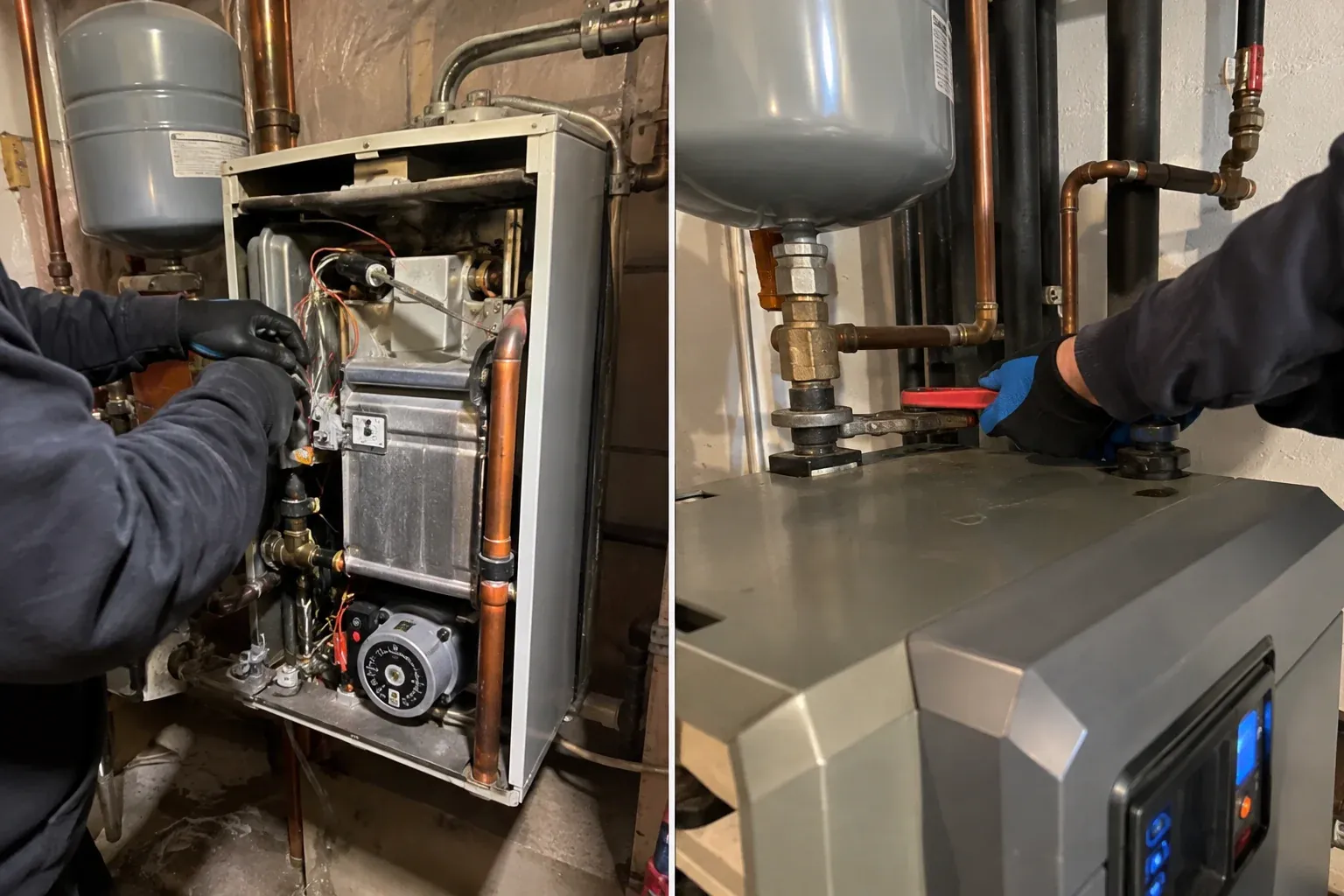
Boilers are not silent machines. A healthy system hums quietly as the burner runs and the pump moves water. But when a new sound appears, or a familiar sound gets louder, the boiler is telling you something. Banging, kettling, humming, gurgling, and whistling each point to different causes, and knowing which sound you hear helps you describe the problem and decide how urgent it is. This guide explains what each noise usually means, the safe checks Brighton homeowners can try, and when the noise needs a professional.
Safety first. If you smell gas, hear your carbon monoxide alarm, or see scorch marks near the boiler, leave the home right away and call 911 or your gas utility from outside. Do not try to trace the noise yourself.
Banging and clunking
Loud banging is the sound that worries homeowners most, and it deserves attention. One common cause is kettling, where mineral scale inside the heat exchanger traps water until it flashes to steam. The steam bubbles collapse with a bang. Another cause is delayed ignition, where gas builds up for a moment before lighting. A third is air or water hammer in the pipework, where a sudden change in flow shakes the pipes.
Water across the Front Range carries dissolved minerals, and over years those minerals can leave scale inside a boiler, especially in a system that has never been flushed or treated. Scale narrows the passages, the water overheats in spots, and the banging begins. If banging is new, loud, or happens every time the boiler fires, stop using the system if you can do so safely and call a professional. Note whether the bang comes at startup, during the run, or at shutdown, since that timing helps narrow the cause.
Kettling: the sound of a kettle
Kettling sounds like a kettle coming to a boil: a rumbling, crackling noise from inside the unit. It happens when scale or sludge slows water flow through the heat exchanger, so the water in contact with the hot metal overheats. The system becomes less efficient, because heat cannot move into the water properly, and the constant overheating stresses the metal.
Kettling does not fix itself. A technician can assess whether a system flush, a cleaning, or water treatment is appropriate for your setup. The right fix depends on how much scale has built up and the condition of the heat exchanger. If kettling is ignored, the extra strain can shorten the life of the unit. A seasonal boiler maintenance visit is the best way to catch scale early, before the noise starts.
Humming and buzzing
A steady hum usually comes from the pump or the fan. A pump hum that grows louder over weeks can mean the pump bearings are wearing or the pump is working against a restriction. A fan hum that changes pitch can point to a worn fan or debris. A buzzing sound near the controls can mean an electrical component, such as a transformer or relay, is struggling.
Humming on its own is rarely an emergency, but a sudden change is worth noting. If the hum comes with no heat, the pump may have stopped moving water. If it comes with a burning smell, turn the boiler off and call a professional. Do not open the casing to look at the pump or fan. Those parts sit behind safety covers and carry live power.
Gurgling and bubbling
Gurgling usually means air is trapped in the system. Air gets in when pressure drops, when radiators are bled, or when a small leak lets air enter. The air collects in radiators and high points, and water bubbling past it makes the gurgling sound. Radiators that are cold at the top and warm at the bottom are the classic sign.
Bleeding the affected radiators can release the air. Use a radiator key, hold a cloth and a small container under the valve, and open it slowly until water appears, then close it. Check the boiler pressure afterward, since bleeding drops pressure. If gurgling returns within days, air is getting in somewhere, and the cause needs to be found. Our guide to boiler pressure too high or too low explains how to read the gauge and top up safely.
Whistling and hissing
A whistle often means water is being forced through a narrow passage, which can happen when scale builds up, a valve is partly closed, or pressure is off. A hiss near a pipe joint or valve can mean steam or water escaping. If you hear hissing and see water, dampness, or a pressure gauge that keeps falling, treat it as a leak and call a professional.
Whistling that starts suddenly after work on the system can mean a valve was left partly closed. Check that radiator valves and any visible isolation valves are fully open. If the whistle continues, or if the pressure gauge reads high, do not keep running the system at full output. A boiler repair visit in Brighton, CO can find whether the cause is scale, a valve, or pressure.
Clicking and tapping
Clicking at startup is often the ignition sparking, and a few clicks before the burner lights can be normal. Repeated clicking with no flame is not normal, and it points to an ignition or gas supply problem. Tapping or ticking from pipes as they warm up is usually expansion, as metal pipework grows slightly with heat. That sound is common in older homes with long pipe runs.
The difference is pattern. Expansion ticking fades as the system warms and returns as it cools. Ignition clicking repeats in a cycle and the boiler may lock out. If your boiler clicks and locks out, note the error code and call a professional rather than resetting it again and again. See our gas boiler repair page for what a visit covers when ignition is involved.
Safe checks to try in order
First, note when the noise happens: at startup, during the run, at shutdown, or all the time. Second, check the pressure gauge and compare it with the normal range for your system. Third, check whether all radiators heat evenly, and bleed any that are cold at the top. Fourth, look for visible leaks, damp patches, or drips near the boiler and pipework. Fifth, check that the thermostat is set correctly and the boiler display shows no error code.
Write down what you find. A note like "loud banging at startup, pressure at 0.5 bar, one radiator cold at the top" tells a technician a great deal and shortens the visit. If the noise is new and loud, or if it comes with no heat, leaks, or a gas smell, skip the checks and call for help.
What NOT to do
Do not open the boiler casing to find the noise. Do not adjust gas valves or ignition parts. Do not keep resetting a boiler that locks out. Do not ignore loud banging in the hope it goes away, since kettling and delayed ignition both get worse with time. And do not use the boiler as usual if you smell gas or the carbon monoxide alarm sounds. Leave the home and call for emergency help from outside.
When to call a professional
Call a professional for loud or repeated banging, any noise that comes with no heat, noise that comes with a leak or falling pressure, ignition clicking that ends in lockout, or any gas smell. A boiler tune-up before winter can catch many of these causes early, from scale buildup to a tired pump. If a noise on this list sounds familiar, reach out through our heating repair service in Brighton, CO. For more early warnings, see our guides to boiler warning signs and what to do after a power cut.