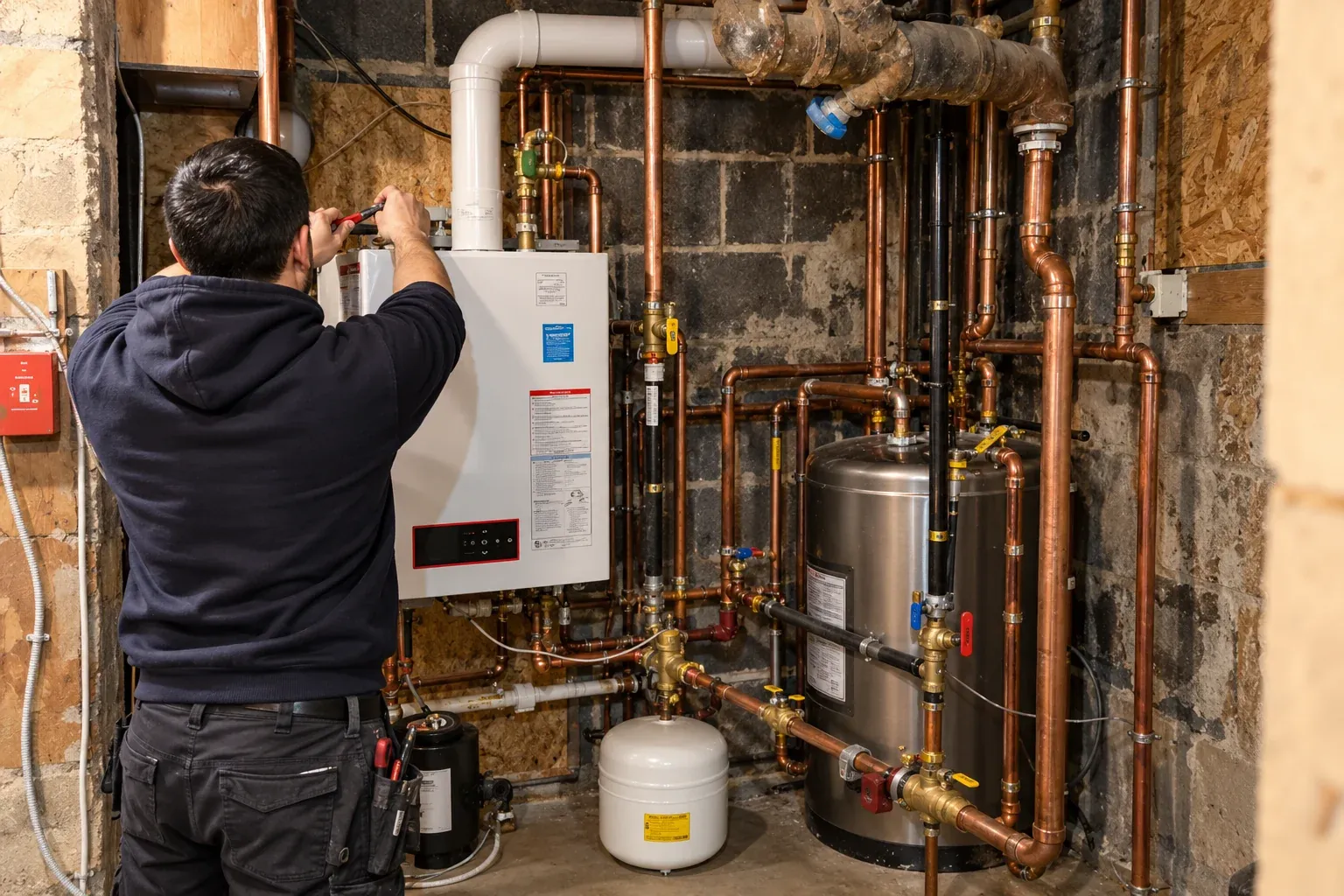
Brighton winters do not wait for a convenient moment. A heavy snow, an ice storm, or a wind event can knock out power for an hour or a night, and when the lights come back on, many homeowners find the house still cold. The boiler sits silent even though the power is back. This is common, and in most cases it has a simple explanation. A modern boiler needs electricity for its controls, ignition, pump, and fan, so a power cut interrupts more than the lights. When power returns, the system often needs a few checks before it will fire again. This guide walks through why that happens, the safe checks to try in order, and when to call a professional.
Safety first. If you smell gas, hear your carbon monoxide alarm, or see scorch marks near the boiler, leave the home right away and call 911 or your gas utility from outside. Do not reset the boiler or touch any gas controls.
Why a power cut stops a boiler
A boiler is a gas appliance, but almost everything that runs it is electric. The thermostat calls for heat, the control board reads sensors, the igniter lights the burner, and the circulator pump moves hot water to your radiators or baseboards. When the power drops, all of that stops at once. When power returns, the control board restarts, and many boilers enter a safety lockout state until they are reset. That lockout is a protective feature. It stops the burner from firing before the system has confirmed that water, pressure, and airflow are all in order.
A power cut can also disturb settings. A thermostat may lose its schedule, a smart thermostat may need to reconnect, and a boiler display may show an error code from the interrupted cycle. In a long outage during a Brighton cold snap, a second problem can appear: an external condensate pipe on a high-efficiency boiler can freeze. A frozen condensate pipe will usually shut the boiler down as a safety measure until it thaws.
Check the power is really back
Start with the obvious, because it is the most common fix. Check that power has fully returned to the whole house. Then check the boiler itself. Most boilers have a fused spur switch or a dedicated breaker. Make sure the switch is on and the breaker has not tripped. If the breaker trips again right away, leave it off and call a professional, since that can point to an electrical fault.
Look at the boiler display. If it is dark, the unit has no power. If it is lit but shows an error code, write the code down before you touch anything. That code tells a technician what the boiler detected, and it saves time on the visit. If the display asks for the time or date, the controls lost their settings in the outage, and resetting the clock is part of getting the heating schedule back.
Reset the boiler controls
Many boilers have a reset button on the front panel, sometimes marked with a flame symbol or the word reset. Press it once and wait. The boiler will run through its startup checks, and you should hear the fan and then the ignition sequence. Give it several minutes. If the boiler locks out again, press reset one more time at most. Repeated resetting is not helpful and can be unsafe on a gas appliance, because each failed attempt can leave unburned gas in the chamber.
If your boiler has a pilot light rather than electronic ignition, the pilot may have gone out during the outage. Some older units allow a homeowner to relight a pilot by following the printed instructions on the unit. If you are not comfortable doing that, or if the pilot will not stay lit, stop and call a professional. Gas parts should only be handled by a trained technician. Our gas boiler repair page explains what a visit covers when ignition is the problem.
Check the thermostat
A thermostat that lost power may wake up in the wrong mode. Confirm it is set to heat, not cool or off, and that the target temperature is above the current room temperature. If the thermostat uses batteries, replace them. Weak batteries are a surprisingly common reason a boiler ignores a call for heat after an outage.
Smart thermostats add one more step. After a power cut, the thermostat may need a minute to reconnect to your home network, and its schedule may revert to a default. Check the app or display to confirm the heating schedule is active, and check its breaker and batteries if it shows no power at all.
Check the pressure gauge
Find the pressure gauge on the front of the boiler or on a nearby pipe. Most home boilers sit near 1 to 1.5 bar (12 to 15 psi) when the system is cold. If the needle sits near zero, low pressure may be keeping the boiler off. Pressure can drop when air is bled from radiators or a small leak lets water out, and the restart is often when low pressure gets noticed.
If pressure is low, the filling loop can usually top it up. Open it slowly, watch the gauge, and close it when the needle reaches the normal range. Do not overfill. If pressure drops again within a day or two, water is escaping somewhere, and the cause needs to be found. Our guide to boiler pressure too high or too low walks through reading the gauge and topping up in more detail.
Listen and look for the usual signs
Once power, thermostat, and pressure check out, listen to the startup. A normal sequence is a fan, a click or spark, and then the burner firing. Repeated clicking with no flame points to an ignition or gas supply issue. A boiler that fires and then shuts off within a minute may be hitting a sensor or airflow fault. Note what you hear and when, since that pattern helps a technician narrow the cause.
Look outside if your boiler is a high-efficiency condensing model. The white plastic condensate pipe that runs to a drain can freeze in a Brighton cold snap, especially during a long outage when no warm water is flowing through it. A frozen pipe often shows as gurgling sounds or a shutdown with a fault code. Warm water poured over the outside of the pipe can thaw it, but never use boiling water or a flame, and never disconnect the pipe. If you are unsure which pipe it is, leave it and call a professional.
What NOT to do after a power cut
Do not keep pressing reset. Two attempts are enough, and further attempts can be unsafe. Do not open the boiler casing. The casing is part of the safety design, and opening it can expose live electrical parts and gas components. Do not adjust gas valves, and do not try to relight a burner if you smell gas.
Do not heat the home with ovens, grills, or outdoor heaters. Those are a carbon monoxide risk in a sealed-up house. Keep the carbon monoxide alarm working, and if it sounds, leave the home and call for emergency help from outside. If the house is getting cold and the boiler will not restart, call for help rather than improvising.
When the outage lasts through a cold night
A long outage in January can leave pipes at risk. While the power is out, keeping one faucet dripping slightly and opening cabinet doors under sinks can help exposed pipes. Once power returns and the boiler restarts, keep the thermostat at a steady setting rather than cranking it up, so the system warms the house gradually and evenly.
If the boiler restarts but some rooms stay cold, trapped air or a zone issue may be involved. Radiators that are warm at the bottom and cold at the top usually hold air. Our guide to why a boiler stops heating covers the common causes, and boiler warning signs lists the symptoms worth watching through the rest of winter.
When to call a professional
Call a professional if the boiler locks out again after two resets, shows the same error code repeatedly, will not ignite, leaks water, or loses pressure again after topping up. Call right away if you smell gas or the carbon monoxide alarm sounds, after leaving the home. A boiler repair visit in Brighton, CO starts with the symptoms and the error code, so have those notes ready when you call.
Power cuts are a fact of life on the Front Range, and most boilers come back with a reset and a few checks. A seasonal boiler maintenance visit before winter helps too, since a clean, well-tuned system restarts more reliably after an outage. If your boiler will not come back after a power cut, reach out through our heating repair service in Brighton, CO and we will help you decide the next step.