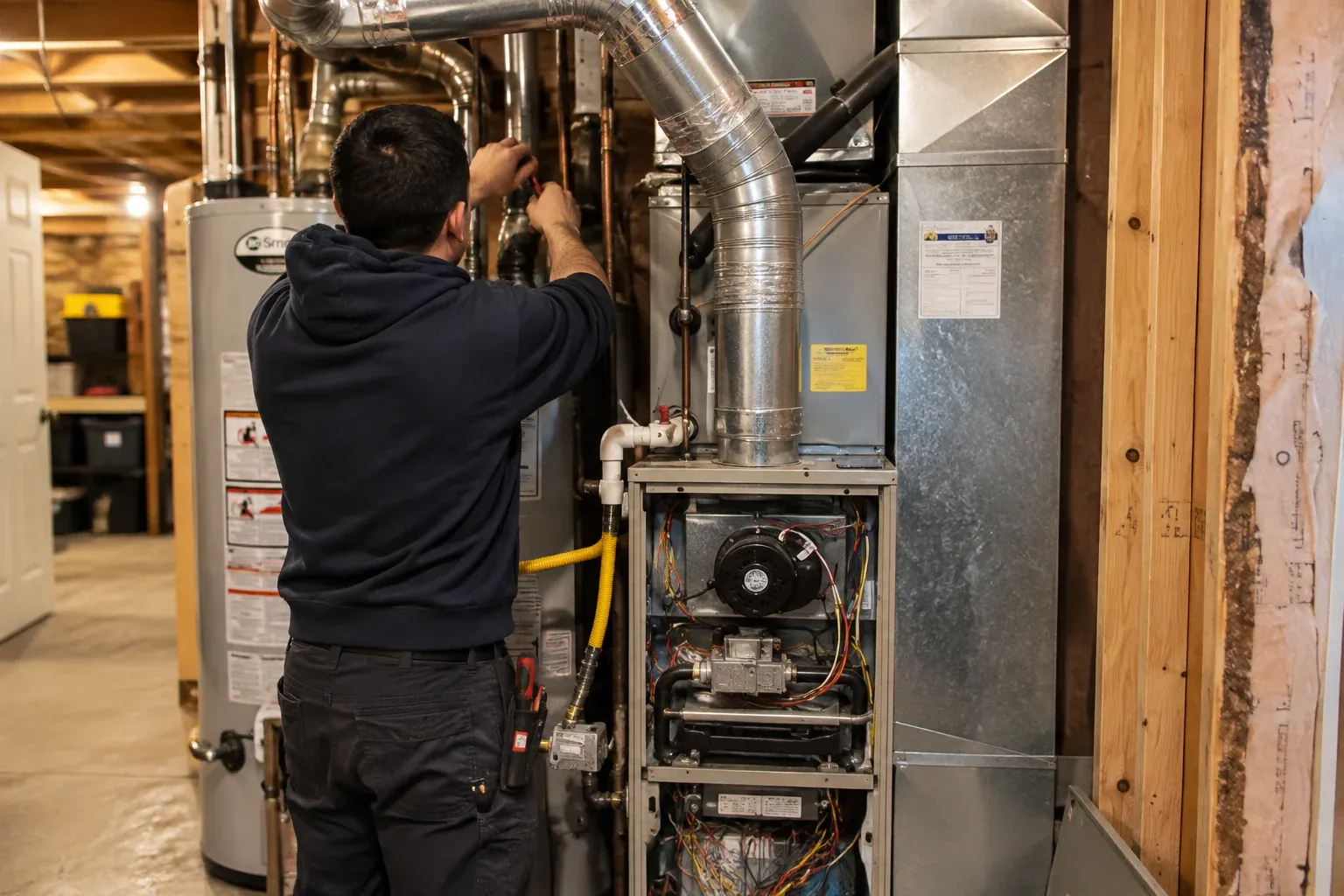
The pressure gauge is the first thing a technician checks on a boiler visit, and it is the easiest thing for a homeowner to read. It shows how much pressure the water in your heating system is under, and that pressure is what pushes hot water through your radiators and baseboards. Too little pressure and the boiler may shut down to protect itself. Too much pressure and safety devices start releasing water. This guide explains how to read the gauge, what normal looks like, the common causes of high and low pressure, the safe fixes you can try, and when to call a professional in Brighton.
Safety first. Hot water from a bleed valve or a discharge pipe can scald. Never open the boiler casing, and never cap or block the pressure relief valve. If you smell gas or hear your carbon monoxide alarm, leave the home and call 911 or your gas utility from outside.
How to read the pressure gauge
Most home boilers have a round dial gauge on the front of the unit, marked in bar or psi, with a green zone showing the normal range. Some newer models show pressure on a digital display instead. Read the gauge when the system is cold for the baseline reading, and again when it is hot, since pressure rises as water heats and expands. If your gauge has no green zone, the manual for your model will state the correct range.
One bar is about 14.5 psi, and many gauges show both scales. A reading of 1 bar is the same as about 14.5 psi. Do not worry about small movements of the needle as the system heats and cools. That is normal expansion. What matters is a reading that sits far outside the normal range, or one that keeps moving in the same direction over days.
What normal pressure looks like
Most home boilers sit near 1 to 1.5 bar (12 to 15 psi) when the system is cold, and rise toward 2 bar (about 29 psi) when hot. The exact figures vary by system, and the manual for your boiler is the authority. If pressure sits below 1 bar when cold, the boiler may refuse to fire. If it climbs above 3 bar, the pressure relief valve will usually open and release water through the discharge pipe.
Pressure that stays in the normal range and returns to the same cold reading each morning is a healthy sign. Pressure that drops a little after radiators are bled, then holds steady after a top-up, is also normal. The problems start when pressure will not hold: dropping again and again, or climbing every time the system heats.
Why pressure drops too low
The most common cause of low pressure is a small leak. Water escapes slowly from a valve, a joint, or a radiator, and the system loses pressure over days or weeks. The leak may be too small to leave a puddle, so check for damp patches, green staining on copper pipes, and rust marks under valves. A second cause is bleeding radiators, which lets water out along with the air. A third is a pressure relief valve that lets water seep past its seal. Recent work on the system, such as a radiator replacement, can also leave the system underfilled.
Low pressure often shows up as a boiler that will not fire, radiators that stay cold at the top, or a gauge needle sitting near zero. If you top up and the pressure holds, the cause may have been a one-time loss. If it drops again, water is escaping somewhere, and the leak needs to be found rather than topped up again and again.
Why pressure climbs too high
High pressure usually comes from too much water in the system. The most common cause is overfilling through the filling loop, or a filling loop that was left slightly open and keeps feeding water in. Another cause is a faulty expansion vessel. The vessel holds a cushion of air that absorbs the expansion of hot water. If that cushion is lost, pressure climbs sharply every time the system heats.
A faulty pressure relief valve can also contribute, since it is the device meant to release water when pressure gets too high. If the valve is stuck, pressure can keep climbing. If the valve is working, you may see water dripping from the discharge pipe outside. Either way, high pressure needs attention, because the safety devices are doing work they should rarely need to do.
How to top up pressure safely
If pressure is low and you can see no leak, topping up through the filling loop is a normal homeowner task. Find the filling loop, usually a short flexible hose with one or two valves under or near the boiler. Check your manual first, since filling loops differ between models. With the system cool, open the valves slowly and watch the gauge. Close the valves when the needle reaches 1 to 1.5 bar. Then check the boiler fires and the radiators warm evenly.
Open the valves slowly. A fast fill can overshoot and push pressure too high. If you cannot find the filling loop, or if the valves are stiff or corroded, leave it and call a professional. Never force a valve. After topping up, check the gauge again the next morning. If it has dropped, water is escaping, and a boiler repair visit in Brighton, CO can find the cause.
How to lower high pressure safely
If pressure is high because the system was overfilled, bleeding a radiator can bring it down. Hold a cloth and a small container under the bleed valve, open it slowly, and let a little water out. Watch the gauge and close the valve when pressure returns to the normal range. Check that the filling loop valves are fully closed afterward, since a loop left open will refill the system and push pressure back up.
Never cap, block, or plug the pressure relief valve or its discharge pipe. That valve is a safety device, and blocking it removes the protection it provides. If water is discharging from the relief pipe, or if pressure climbs again after bleeding, the expansion vessel or the filling loop is likely at fault, and a professional should check it. A boiler maintenance visit covers the expansion vessel, the relief valve, and the filling loop.
When pressure keeps moving
Pressure that keeps dropping after every top-up means water is leaving the system. The leak may be hidden under floors or inside walls, and finding it takes a methodical check of the pipework, valves, and radiators. Pressure that keeps rising after every bleed means the expansion cushion is gone or the filling loop is passing water. Both patterns need a professional, because the cause is a component fault rather than a one-time loss.
Keep a simple log: the gauge reading each morning, whether you topped up or bled, and whether any radiators stayed cold. That log shows the pattern clearly and helps a technician find the fault faster. Mention it when you call, along with the boiler make and model if you know it.
Gas and water safety notes
Water and electricity do not mix. If you see water near the boiler electrics, the fused spur switch, or any outlet, do not touch the switch with wet hands. Turn off power at the breaker if you can do so safely and call a professional. Hot water from a bleed valve or a discharge pipe can scald, so use a cloth and a container, and keep children away while you work.
If you smell gas at any point, leave the home and call your gas utility or 911 from outside. Do not use phones, switches, or appliances inside until the home is declared safe. If the carbon monoxide alarm sounds, leave the home and call for emergency help from outside. These steps matter more than any pressure reading.
When to call a professional
Call a professional if pressure drops again after topping up, climbs again after bleeding, the relief valve discharges water, you find a leak you cannot trace, or the boiler will not fire even with normal pressure. A boiler tune-up before winter checks the pressure, the expansion vessel, and the safety devices together. If your gauge has been moving in one direction for days, reach out through our heating repair service in Brighton, CO. For related symptoms, see our guides to boiler noises, boiler warning signs, and boilers after a power cut.